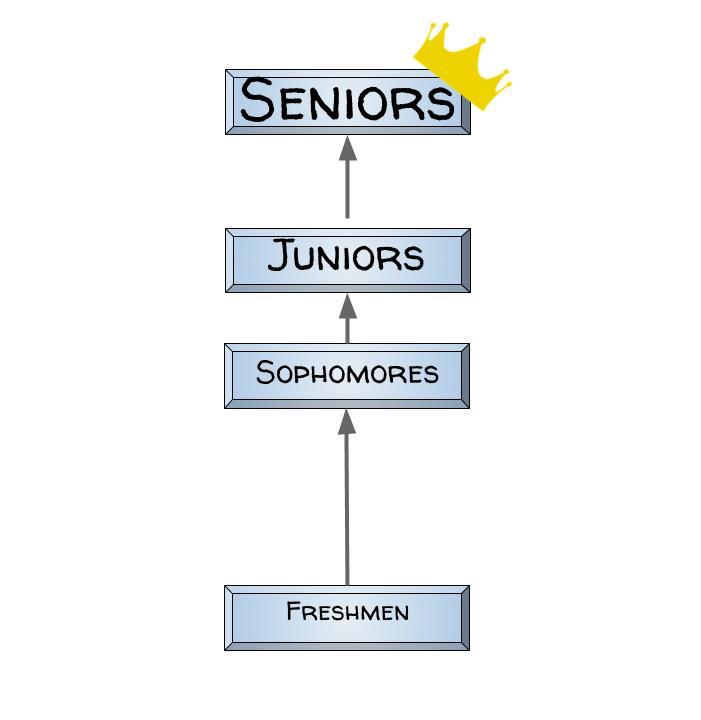
It's the quintessential argument of all those who have spent long enough at Spence to know the situation at hand: we had to wait, so why shouldn’t they?
A sizable portion of my headspace during my first year of high school was dedicated to the senior question: respecting the boundary of the Commons, not sitting at the senior library tables, and most importantly, not entering the elevator (at least, not when seniors were inside). Respecting “senior territory” made sense, even though it was slightly frustrating: these seniors had waited for these privileges, so we would have to wait as well. I loyally followed that assumption throughout ninth and tenth grade, but in the beginning of junior year, I began to consider the senior question further.
The homemade sign placed haphazardly on the Commons barrier saying “2024 only” stared at me every time I made my way to the Townhouse– a reminder that my senior year was only a year away. This sign meant that the burden of college applications was a year away, but also, the question of how I wanted to govern myself as a senior. Would I guard the commons with as much fervor as some of the seniors of 2024 were doing? Or would I turn a blind eye to the hordes of underclassmen entering the elevator? I asked one of my senior friends what she thought of enforcing the senior spaces, and she provided a simple answer: the class of 2024 was poorly treated by the seniors each year, so they would be strict as well. It seemed implied that as seniors, you replicated the treatment you received from the seniors before you. As a freshman, my relationship with the Class of 2022 was built largely on fear. The question was whether the class of 2028’s relationship with 2025 would be similar.
As I navigate my senior fall, I have come to realize the true meaning of the adjective “senior”: its importance and its implications. Labeling spaces as “senior” raises the question of what truly belongs to the senior class. Yes, designating tables and common spaces makes life more convenient for the seniors, but that designation is a reminder that our time at Spence is coming to an end. Those senior privileges are a reminder of the last things seniors will hold at Spence– the final hurrah of however many years were spent. In a year full of uncertainty, telling someone to get out of the elevator might feel like the one source of power you have. And, while I understand the frustration and uncertainty accompanying senior year (trust me), I’m looking for other ways to channel those emotions– perhaps into creating a different sense of constancy, one not built on disciplining the underclassmen but creating relationships with them. While seniority usually implies having greater knowledge, I would argue that seniors and freshmen are both at a crossroads: faced with their future ahead of them. Whether it’s bringing leftover donuts to the Commons, blasting music and having a dance party, and even maybe waving to the freshmen from inside our border, I feel that my grade does well at channeling their frustration in non-disciplinary ways– the rest of the year serves as the perfect canvas to hopefully continue creating those connections.
- Jules Bason '25